Showing posts with label Shoe review. Show all posts

Monday, February 6, 2012

Saucony Mirage Shoe Review

     Up next in the shoe review series is the Saucony ProGrid Mirage, a light stability road shoe. Introduced as a new model in June '11, the Mirage is another shoe in the stable of Saucony 4mm drop lightweight daily trainers, this one aimed at those who prefer a minimal amount of stability.

One of several color combos, this white is super white white.

     The fit of the Mirage is a little different than what I have found typical of Saucony in that it is fairly roomy all around, other than the beneficially slightly snug heel. The midfoot is maybe slightly more full than usual also but there are straps built into the lacing that integrate with overlays and snugs both sides to your foot as you adjust and tie the laces, and this system works well to connect your foot comfortably to the shoe. The forefoot is also fairly wide and fits my D width foot very well. The upper from midfoot forward is very simple and unrestrained, and is made of a soft open mesh type material that stretches some as your foot moves, making the shoe feel larger than it is without feeling sloppy or loose, a nifty trick.


Weight saving open mesh upper and judiciously applied outsole.


     The Mirage is considered a light weight trainer and my size 10 weigh in at 9.75 oz. but they feel lighter than that in stride. At 26mm heel and 21mm forefoot with sock liner included, the midsole has a nice firm feeling underfoot and gives a smooth ride from easy to tempo paced running.


Concave support piece seen here as the arch in the medial midsole.

     I should say that I have always worn neutral designed shoes before, and the Mirage is my second pair of mild support shoes. The Saucony Fastwitch 5 is my first and will be reviewed in the near future. It's been interesting to experiment with light support shoes and I'm glad I got over the bugaboo of staying within your assigned category, but I would not venture further than light support. The difference I can tell is all about the arch area. Not more or higher arch per se, but there is a feeling of more area underfoot overall, giving a more, well, stable feeling, like the platform of the shoe is wider. It feels good to me and I adjusted immediately and liked it right off. I run some of my road miles out on county highways that are fairly steeply crowned and when traffic forces me from the more level center to the slanted edge of the road this extra stability seems to help correct that cant somewhat.

     One complaint about the Mirage is what Saucony calls the "Hydrator Collar Lining", a thicker roll of foam that lines the upper interior of the collar and also the tongue. No doubt added by the Superfluous Gizmo Dept. of the design crew, this feature is more annoying than useful to me. Not uncomfortable, but noticeable as a wad of foam against your ankle, at least until it compresses with a little wear. Where the upper corners of the tongue meet the collar and overlap in use, this doubling of the foam can force the tongue to slide sideways, which is a little uncomfortable and could potentially rub during a longer run, though I have not had a hot spot yet as a result. I can't figure why, but this happens more with one shoe than the other, and is inconsistent with different pairs. I decided to tackle it somehow and wound up putting a stitch to connect the medial side of the tongue directly to the shoe and- problem solved. This whole thing might be unique to my feet/stride/karma also, who knows.


A tailor I'm not, but hey- it worked!


           Overall, this shoe fits very well, rides smoothly and stays very comfortable on longer and pace runs. As a result I have committed to the Mirage for the road portion of my marathon training and have been very happy with it. In fact I got an extra pair to wear around just as a daily shoe.

     The Saucony Mirage retails for $100, and Saucony is just now on the verge of releasing the Mirage 2.

Monday, January 16, 2012

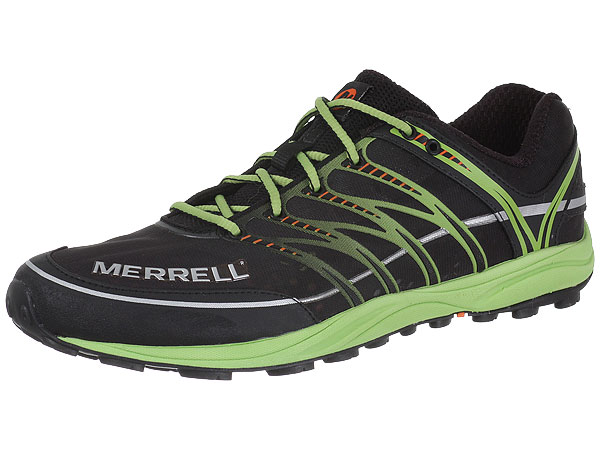
Shoe Review- Merrell Mix Master

     Next up in the shoe review series is the Merrell Mix Master, a new neutral trail shoe introduced just this past December, and one I was looking forward to soon after reading of it. It has many design features I thought would work very well for me, and you know what? They do!

Merrell Mix Master- black and blech.
     I don't know a lot about Merrell, my experience with them is limited to a pair of their Trail Gloves introduced early last year, which I also like. Both shoes are very well made and the fit is fairly similar as well. Pretty standard length, close fit in the heel, fairly full midfoot that wraps the arch area snugly and a wide forefoot. This is a good design that provides a secure overall fit that keeps the foot stable in the shoe when going downhill, yet still allows plenty of room for natural foot movement within the shoe while landing. This can be a tricky fit to achieve, and Merrell seems to have it nailed. In fact I was a little worried my usual size 10 might be a little big, but now that they have settled in I feel the fit is about perfect.

The forefoot feels wider than it appears here. Magic! 
     My size 10 weigh in at 8.45 ounces which is great as it is, but they feel even lighter when running. It's neat how some shoes do that, so even better. The 16mm heel and 12mm forefoot make for another 4mm drop shoe, one of a growing number among varying manufacturers. It's my sweet spot and must be for others as well. The midsole is firm but offers enough cushioning to easily handle all the trail conditions I have seen so far. A big test for me is how rocks feel both under the forefoot and landing on one with the heel, especially when going downhill. While you can feel the surface beneath your foot, other than really sharp pointy rocks that would be a problem for any shoe the Mix Masters take them well in-stride. (Oops) There is a rock shield in the forefoot for added protection, yet the sole is very flexible as well and the overall ride is very smooth as a result.

How they look to the trail. The forefoot rock plate is visible as the orange dots.
     Traction is another big test for me as I need to really trust my grip on the ground in all reasonable conditions. Otherwise my gait stiffens and trouble soon ensues. The Mix Master has terrific gripulation on par with the Saucony Peregrine, which I consider flawless in that regard. I have run uphill and down in loose gravel, mud, wet rocks and wood, and just today in the snow and have never slipped once, so yay! In fact I looked at my tracks in the snow and noticed the lugged treads have a sort of swirling pattern that flows from heel to toe. Then I realized I was getting all "A Beautiful Mind" and staring at my tracks, but I thought it was interesting.

Traction galore!
     Overall I really like these shoes and they are even improving with wear after about 35 miles. They are well made and I anticipate they should last at least comparably to most shoes and likely longer than most. I wouldn't use them for long road runs even though they are touted as such, (thus the 'Mix Master' name) but that's maybe just me. I was hoping these would fall between the Peregrine and NB110 for weight and protection and that's just about right. Not sure yet if they will replace the Peregrine as my ready-for-all-conditions/distances daily shoe but that is my plan for now, and I'll update this with further experience.  So far the only negatives are the color, not being a fan of weird green, and the name, which makes them sound like a kitchen appliance. In short, no complaints so far.

     The Merrell Mix Master trail shoe retails for $110. 

Sunday, January 1, 2012

Shoe Review- Saucony Peregrine

     I thought I should start my running shoe review series with the shoe I have probably put the most miles in this year, though the Altra Instinct is a very close second. A review of the Instinct (and Lone Peak) will be forthcoming.

Peregrine, all dolled up for photo shoot.

     The Saucony Progrid Peregrine is a neutral trail shoe built as a new model in February 2010. Following on the heels (my bad) of the wildly popular Kinvara, the Peregrine is loosely a trail version of that shoe. With a 4mm drop from heel to toe, relatively light weight of just under 10 ounces (for my size 10 pair) and a fair amount of firmer-than-soft cushioning the Peregrine makes a fine choice as a daily trainer for runs of any distance. A deeply lugged outsole provides flawless traction in all conditions I have encountered, including mud, wet wood, mossy rocks and snow, and other than perhaps ice I can't imagine traction ever being a concern with this shoe.

And after many miles in the real world. Those lugs offer superlative traction.

     The fit is pretty typically Saucony, and by that I mean average length, a fairly snug heel and form-fitting midfoot, and (for my foot) barely wide enough forefoot. In fact the forefoot of the Peregrine is narrow even by Saucony standards and was initially a problem significant enough that I nearly ruled the shoe out.Wanting to try and make these otherwise promising shoes work I swapped the insoles from an old pair of unused shoes and cut the forefoot off to allow more room for my foot, and that worked great. As the shoes loosened up with use I was able to replace the original insoles and they now have a comfortable fit overall.

##Update##  I recently got a second pair of Peregrines on super cheapo close-out and after a short debate got the same size as this review pair. I was a little worried about a repeat of the narrow-ish forefoot problem I describe here but didn't want to go up to a too-large size either. Thing is, this new pair-they fit great right out of the box. The forefoot is plenty wide and the shoes are ridiculously comfortable. After a muddy trail run just now they aren't new any more, but they sure do fit and ride well and I'm very happy with them. I've heard of variances in color and fit with different pairs of the same model shoe but this is the first I've noticed it. But- is the narrow pair or this pair the 'normal' example of the Peregrine?
##UpdatedUpdate##I can now say with confidence the wider forefoot is the norm, and my first pair were an exception. So all I said about it being narrow- just ignore that.


Insole I cut to provide more forefoot room until the shoe loosened up enough.


     The Peregrine rides very well with enough cushion to be comfortable for the longest runs I can manage. Comfortable enough also for a short run on pavement, they worked well on snow-covered roads last Winter. I have put many trail miles on my pair while alternating pretty equally with the Instinct since late last Winter, through the Summer right up until now, nearly a year's use. The 4mm drop is a real sweet spot for me and along with the forefoot rockplate, I have found the firm cushioning to be just the right amount to strike a good balance between protection, comfort and conservative weight/height.

     Until recently light weight trail shoes were a contradiction, but now there are an ever-increasing number to choose from as manufacturers feed the desires of their market. As a trail runner with a self-imposed 10oz weight limit it's great to see so many choices. The Peregrine, despite its narrow forefoot, has worked very well for me but before I replace these with a new pair I'm waiting to try some other new models- Merrell Mix Master on the way as I write, Saucony is apparently making a direct trail version of the Kinvara, Asics has the Fuji Racer,  Brooks recently busted out with the Pure Grit, and I'm so far really enjoying my New Balance MT110's also.

     The Peregrine retails for $90. Saucony will update with the Peregrine 2 in March.